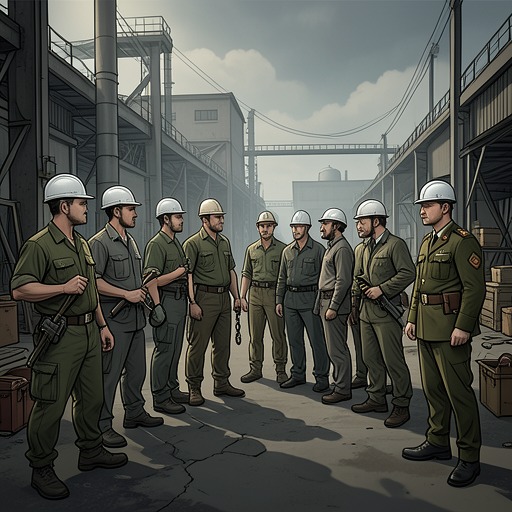
Suitbert Seedig
The Zone of InterestSuitbert Seedig is a doctor and senior administrator whose appearances link the administration of forced labor to the industrial project at Buna-Werke. He discusses the exhausted prisoners needed for the factory, helps define the division of responsibility between the camp and Farben, and later reports worsening conditions under Rupprecht Strunck. His career ends not with the promised production of synthetic materials but with a conviction for slavery and mass murder; Buna-Werke never produces a kilogram of synthetic rubber or a millilitre of synthetic fuel.
Identity and Administrative Role
Seedig appears less as a privately developed character than as a figure of institutional responsibility. The narrative locates him among the officials who manage the relationship between the concentration camp and Farben’s industrial interests. At a meeting in the Main Administrative Building, Frithuric Burckl and Angelus Thomsen are also present as Paul Doll discusses who will pay for the proposed arrangement. Seedig sets out the division of duties: Doll is to provide prisoners and guards, and retain overall security, while Farben pays construction and running costs. Burckl adds that the company will supply food independently of the camp’s ordinary system, with the hope of avoiding typhus.
The arrangement makes the camp’s economic function explicit. Prisoners and guards remain under the Commandant’s authority, while a private industrial concern undertakes the expense of a separate worksite and its provisions. Seedig does not present this as a moral question; his contribution is to specify the administrative terms. The novel’s emphasis on who supplies labor, who controls security, and who covers costs shows how exploitation is organized through apparently practical allocations of responsibility.
Labor and the Buna-Werke
Seedig’s concern with labor is also expressed through the daily schedule imposed on prisoners. He describes reveille at three in the morning, a ninety-minute march to Buna, work ending at six in the evening, and a return to camp at eight. Prisoners are already exhausted before the workday begins, and they carry casualties on the journey back. His question is how any work can be obtained from people subjected to such a routine. The observation identifies the system’s material contradiction: the camp demands labor while its own schedule, violence, and deprivation undermine the bodies on which industrial output depends.
The discussion does not establish that Seedig opposes forced labor or the camp system. It shows him raising the question of productivity within them. Later, Frithuric proposes selecting a core workforce of roughly twenty-five hundred, ending beatings and the constant double-time pace, and providing better food and housing in exchange for work. When Doll asks what Seedig would say, Frithuric answers that he can persuade him. The exchange indicates that Seedig’s support matters to the proposal, but it does not disclose his response or establish that he accepted it. The distinction is important: the narrative records his administrative influence without supplying a private account of his beliefs.
Reports, Sabotage, and Institutional Secrecy
Seedig reappears in the crisis over sabotage at Buna-Werke. At an emergency meeting in the Political Department with Doll, Fritz Mobius, and Rupprecht Strunck, he reports that rivets have been weakened so they will give way and that pressure gauges have been skewed to produce false readings. These are deliberate interventions in the plant’s machinery and measurements, not merely failures of maintenance. Strunck suspects a network of saboteurs, a coordinator on the factory floor, and an accomplice inside Farben; the meeting treats the damage as a threat to the industrial project and its security.
Yet Seedig is not entrusted with every part of the investigation. Mobius reports that an English NCO, Jenkins, has been detained and warns Doll not to tell Farben, Seedig, or Strunck what is happening to him. Jenkins is held in a crouchbox and is to be interrogated by Michael Off and then Professor Entress. Seedig’s presence at the emergency summit therefore does not mean he has full access to the investigation. The episode reveals an administrative hierarchy in which officials can share responsibility for identifying sabotage while information about coercive interrogation is restricted even from senior figures involved in the crisis.
Seedig also communicates through written reports. In a confidential addendum to his weekly account, he describes Strunck’s abolition of the double-time pace: prisoners now work at a sprint. The Main Yard, in Seedig’s account, resembles an anthill in the middle of a forest fire. The image converts an administrative report into a measure of disorder and danger. It also marks a deterioration from an already punishing labor regime: the change is not relief but a further acceleration imposed on prisoners.
Defeat and Legal Consequences
The record of Seedig’s work culminates in the postwar prosecution of Farben’s managers and executives. Thirteen were convicted at the Nuremberg Trials, though Burckl was not among them. Seedig received an eight-year prison sentence for slavery and mass murder. The judgment gives legal consequence to the forms of responsibility that the earlier scenes distribute among officials, employers, and camp authorities: labor allocation and industrial administration are not separate from the violence that makes them possible.
The fate of Buna-Werke sharpens the ending. Despite the extensive arrangements for construction, labor, food, guards, and security, the plant never produces synthetic rubber or synthetic fuel. The promised industrial return is absent, while Seedig’s conviction records the human crimes bound up with the attempt to obtain it. His arc is consequently defined by the distance between administrative purpose and outcome: the project fails at production, but its exploitation and mass violence remain fully consequential.